Wessam and I met through the ‘Introduction to Arabic Language and Culture’ class she is teaching at University College Utrecht (Spring Semester, 2026). In many ways, I am simply a student of the Arab language. However, this holds true only if one could confidently say Wessam’s lectures are just classes. While she is teaching me how to handle new, tricky grammar and writing systems, besides familiarising myself with the Arab world’s music, cuisine and traditions, her life story and class activities suggests she is doing much more.
It’s not only about the language I am teaching, but also about what this language carries, Wessam tells me, spelling out a feeling I constantly had in her class but couldn’t name.
Then, in many ways, I am also learning how to understand the Arab world with all its complexities, which the West covered under the very straightforward image of threat. This very image is the reference point which local communities often refer to when people from the Arab world migrate.
In my case, this image of threat started to disappear when I realised Arabic is the only language from the three I speak that is inexplicably related to the culture of its people. Consider how, in Arabic, the linear Good morning! Good morning! greeting exchange we are used to in English is absent. Instead, Arabic greetings are carriers of core cultural values: generosity, dignity, belongingness and solidarity. It so happens that when Wessam taught me that there is no Good morning! in Arabic, I started seeing this threatening image crack. In Arabic, there is only Have a morning full of light! (literally), to which you respond with And you have a morning full of wellness and roses! (also literally). In Arabic, you don’t mirror a greeting, you simply give back more. It is in this more that I found no threat, and maybe, if more people had the chance to be taught by Wessam, the process of welcoming migrants in local communities would be smoother.
As cliché as it may sound, the popular Arabic greeting ‘Ahlan wa-sahlan (transliterated) is a shorter version of Welcome, you have come to people who are like your folk and to a place that is smooth (literally). This is but one of the ways the Arab world, home of the arguably most misunderstood communities in the world, expresses its culture into its language(s). This leaves outside many complexities, but I hope it makes the point of why Wessam, whose story starts with an (apparently) inexplicable interest to teach Arabic to foreign exchange students during her Bachelor’s in Egypt, chose to do what she does today.
Wessam’s journey started in the early 2000s, when she was studying Arabic Language and Literature for her Bachelor’s in Cairo (Egypt), her home. Ever since, her journey has made her walk through Arabic literature, a Diploma of Education in teaching Arabic as a foreign language, and a Master’s in Applied Linguistics, all which she used to do what she does today. For many years, her journey took place in the Arab world, where she was an Arabic teacher for non-native speakers at several culture and language centers, but also institutes, both in Egypt and Oman.
It was an odd thing, she tells me, to go on a different path than my colleagues. Most of them chose to teach Arabic Language and Literature in universities in Egypt to native speakers. I went on a less traditional path: teaching Arabic Language and Culture to non-native speakers.
In that regard, for Wessam, the uncertainty was bigger, but so was the reward which came later. During her Master’s at the American University in Cairo (AUC), she had to make a choice regarding the opportunity to study and teach abroad for 10 months, which she had never really given much thought to before her supervisor grabbed her attention. As exciting as it may sound, learning to walk a new ground also requires you to go outside your comfort zone.
I’m not sure if I can live outside Egypt is what Wessam told her supervisor outright, who kept encouraging her to treat this experience as a decision-making opportunity for later.
It turns out her supervisor was onto something. Once at Leiden University in the Netherlands, Wessam was immersed in a new environment, brimming with people from every corner in the world, for the first time with such people outside her hometown. She also met her partner, now husband and father of her daughter, and, funnily enough, a series of unfortunate events such as the COVID-19 lockdown worked somehow in her favour.
These are some of these things that influenced her decision to stay in the Netherlands. Far from being easy, she started making her way through Dutch culture. She had to learn Dutch online, look for a job, and figure out all sorts of logistical steps for migration, all while living a very beautiful but challenging life between cultures.
It was hard to build my image here, she says. When you leave your country of origin, you don’t just leave a home, your parents, cultural artifacts (music, food, art). You leave what you built as well, and you have to carry that experience with you to build your image again, in the new country you’ll inhabit.
She recalls how successful she was in Egypt. To this, I want to add that her words prove how time and place play in many unfair ways with success and image when a person is migrating. In the 5 years she has been living in the Netherlands, Wessam had to build anew her image of success, whereas in Egypt, the many years she already lived there among her people built this image without her having to put in extra effort. In many ways, migration is both a loss and a win.
During those 10 months of studying and teaching colloquial Egyptian Arabic to other students (some of them colleagues from the courses she was taking), Wessam realised language-teaching becomes trickier when the system only rewards teaching the grammar, and not what the grammar carries. Back in Cairo, the incoming foreign students were immersed in the Arabic and Egyptian culture, which meant that Wessam spent less time explaining the culture, because the culture was explaining itself. She also notes how, while she knew these foreign students who came to her hometown carried stereotypes about the Arab world, she also noticed they were not actively participating in feeding those stereotypes. Considering they were in a space where their stereotypes could be deconstructed while the actual Arab world revealed to themselves, they learned how to be aware and respectful of cultural differences. In Leiden, however, she faced 2 main difficulties: (i) she was expected to teach only grammar, and (ii) her students were not in Egypt. Especially when the students are in a Western dominant culture, deconstructing stereotypes happens less successfully and less directly.
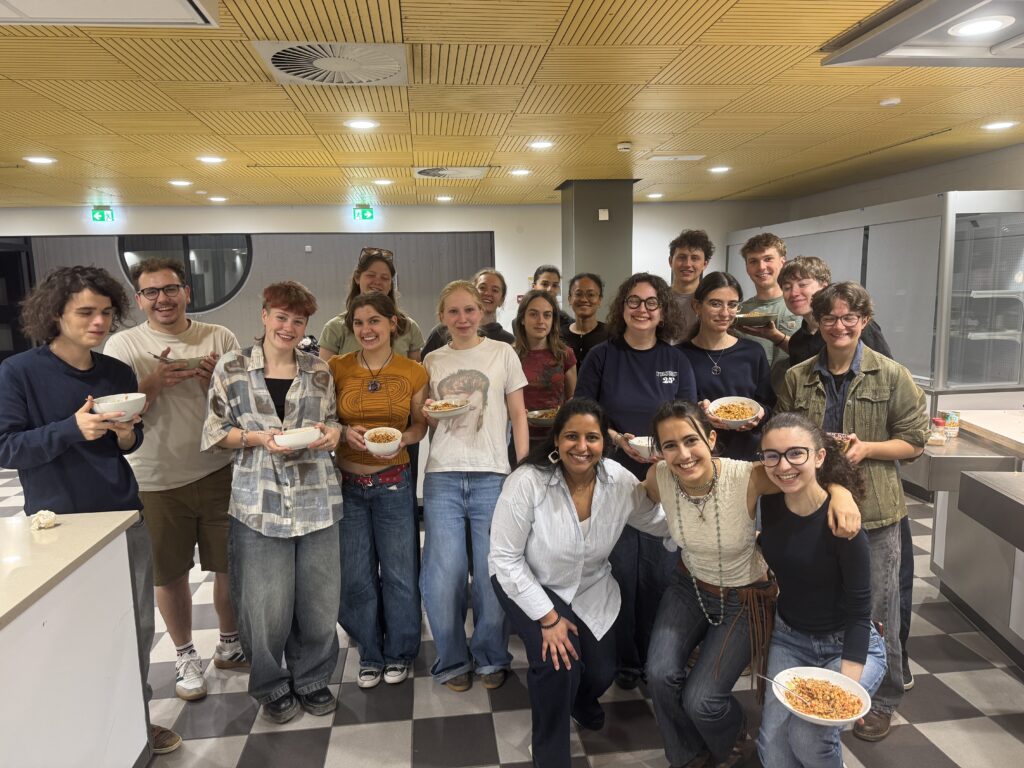
The true change came when Wessam started teaching ‘Arabic Language and Culture’ at University College Utrecht (UCU) in 2021. Because UCU is an international residential college, everyone has a mixed background, which helped Wessam feel at home. All of a sudden, she had something in common with these students: a life in-between cultures. Teaching 28 students every year, multiple cohorts per year, all from different corners of the world, united in studying the Arabic language and culture was a vessel that allowed Wessam to pour her experience and aspirations into. Those structural barriers she faced while first teaching at Leiden started to dissolve, and she found herself finally in the position of incorporating the culture part in her teaching. You might now wonder, Is this working?
Consider how now, on a random Tuesday night, I sit with my flatmates, also UCU students, who have no connection whatsoever with Arabic, and tell them about this language which carries the actual history, values, culture and norms of Arab people. The funniest part is how they engage in the conversation and are so impressed that they also tell their families and friends about it. So, to answer the question: if creating a circle of people who unknowingly ameliorates the image of threat dominant cultures created for Arab people is what makes a small but consistent change, then yes… It is working.
Wessam dreams of doing more and offering more, just like her culture taught her. Her hope is to develop an Arabic Studies track at UCU. Although many aspects of the Arabic courses improved over time at UCU, the journey has not yet ended.
But Wessam’s journey continues also outside the classroom, where Wessam also lives in-between cultures.
She met her Dutch husband through a mutual friend. When Wessam came to Leiden on exchange, she talked to a new acquaintance. It turned out this person knew someone who was interested in learning Arabic and was actually at the moment at AUC (Wessam’s home university in Cairo). Funnily enough, that someone was her now-husband. It so happens that when Wessam came to Leiden, where her husband is from, her husband went to Cairo, where Wessam is from. When he returned to Leiden, they met. The rest is history.
Against all odds, her decision to stay has not been easy, even if she had not missed, or thought with sadness about Cairo. Her 10-month stay, she argues, was like a honeymoon phase. These aspects echo in her life nowadays, when she finds herself missing her Cairo. Even though she, her husband and daughter visit Egypt twice a year to reunite with Wessam’s nuclear family, this does not mean revisiting home comes without difficulties either. When she is back in Egypt, she says she oddly feels she is not 100% Egyptian anymore. She also adds that she does not feel 100% Dutch either, despite living in the Netherlands. In other words, migration changes you, because, again, migration is both a loss and a win.
Now, Wessam says, I’m somewhere between. This illustrates that her story, and many other migrants’ stories, are not stories of assimilation or isolation, of becoming Dutch or staying only Egyptian.
This is especially visible in how a life between cultures brings many micro-moments of awkwardness or small frictions which speak a thousand words on how humans are all the same, except they are brought up in different places, which manages their zones of comfort.
These micro-moments, as Wessam tells me, often manifest in ordinary spaces, such as the dinner table, where the usual ways to exist in a shared space differ across cultures. Having a Dutch husband meant navigating Dutch in-laws and a set of table manners that felt alien to her Egyptian upbringing. Back home, finishing a meal led to retreating to a nearby couch, as to stay at the table was to risk appearing as though you were staring at others’ plates. In the Netherlands, however, the table is the anchor of the evening, and leaving it creates confusion.
Even serving the food illustrates this. In Egypt, a clean plate is a question to your host, who immediately answers by refilling your portion. Her husband, playing by Dutch rules of efficiency and politeness, often found himself unintentionally overeating in Cairo simply by finishing his plate, which Wessam’s mother took care of. Conversely, Wessam learned the difficult way that in the Netherlands, a no is taken at face value. While Arabic culture relies on the dance of face-saving, where one refuses an offer initially out of dignity, fully expecting a persistent host to insist, the Dutch respect for directness means that if you say no, you simply go without.
These scripts we follow, which create our zones of comfort, extend even to the threshold of the home. The simple, respectful act of removing shoes upon entry, simply a given in Cairo, is met with surprise in Dutch circles. Wessam’s professional life presents these differences as well, where her colleagues are explicit and firm in their refusals, while she finds herself sometimes softening her no, a lingering habit of Egyptian politeness. Whether it is the nuance of a hug, the weight of an opinion, or the way one greets a stranger, these moments highlight the implications of living in-between.
Migrants often exist in such gaps where ‘direct’ can feel ‘aggressive’ and ‘polite’ can feel ‘evasive,’ forever translating themselves, just like Wessam is translating herself for two worlds that don’t always share the same vocabulary. In a way, cultural differences are just like different languages, and it is a pity we do not see them as such.
Therefore, while many migrant stories focus on the clash and incompatibility of the cultures they live between, Wessam’s story deepens our understanding of how this works from the personal level to the societal one. The main takeaway from Wessam’s story is that migrants don’t just move their bodies. They also move their specific cultural baggage that the new environment often fails to see or value until it is intentionally unpacked through education.
The main takeaway from Wessam’s story is that when one moves to a new country, one doesn’t just pack their clothes. One also packs their way of being: the way one greets, the way one offers food, the way one values hospitality. Wessam’s journey suggests that having a migration story is the brave act of living between two houses. Wessam’s story as an Arabic teacher also suggests that language is one of the houses we live in, and not just a tool we use. This lesson is especially visible in my random conversations with my flatmates about what I learn in Wessam’s classes. It suggests that global misunderstandings and deep-seated stereotypes don’t start being deconstructed by grand political gestures, but by human storytelling. If I learn from Wessam, and my flatmates learn from me, and their families learn from them, a path forward is created. It is this path of amelioration that proves how a single teacher in a classroom in Utrecht inspires a change in how the West views the Arab world. It turns out that once spread, empathy is contagious and slow-burning. Most surprisingly: it was sparked up by something everyone takes for granted: language.
written by Andrei Bontas (student at University College Utrecht).