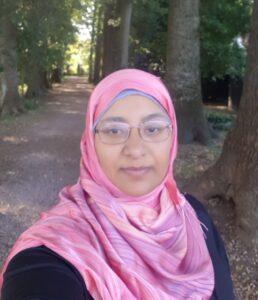
Rehab Darwish used to be a political journalist in Egypt. Now she is doing a traineeship in project management and volunteers to help Arabic-speaking newcomers navigate Dutch bureaucracy. The distance between those two sentences contains eleven years, three countries, four children, a violent divorce, a brother who has been in prison for seven years without a trial, and a revolution that lasted long enough to make people believe in something before it was taken away.
In 2013, the Egyptian military removed the elected government. What followed, Rehab describes without drama, the way people describe things they have had a long time to think about. The police were given by the president, in a public address, permission to silence people protesting oppression. He told them: do what you want, and no one can judge you. The officers understood this as permission for detention, for torture, for sexual abuse. Journalists were among the first targets.
Rehab was one of them. She moved her family first to another city within Egypt, hoping that distance inside the country might offer protection. It did not. By 2015, there was nothing left to try but leaving. She went to Malaysia, where she stayed for two years. Malaysia offered no path to residency, no stable ground. Then South Korea, which formally accepts refugees but, as Rehab explains, places them in conditions that make genuine settlement nearly impossible. There, work was available only far below a person’s qualifications. There, schools struggle to hold children who are already exhausted from displacement. I couldn’t continue there, she says simply.
In 2019, she arrived in the Netherlands with her four children. The oldest was then around five; the youngest has been born here, into Dutch air and Dutch paperwork and a language that still does not fully open itself to his mother. She remembers the first day. I was a little shocked, the people here are very tall. She laughs, briefly. I felt very tiny beside them. But also: the people were respectful, they spoke kindly, and her children, too small to understand migration, experienced it as something close to adventure.
Her brother – one of several – has been in an Egyptian prison for seven years. No trial. No court date. Just because he is a journalist.
This sentence, delivered without flourish, is perhaps the most important one in the conversation. It is the sentence that explains why Rehab is sitting in Utrecht and not in the small city near Cairo where she grew up. It is the sentence that explains why she spent eleven years writing online, from three countries, about a place she could not return to. And it is the sentence that most people in the Netherlands, including many who hold strong opinions about journalism, democracy, and human rights, will never have to carry personally.
The consequences of political speech in Egypt, Rehab explains, do not fall only on the person who speaks. When security forces cannot find a journalist, they arrest family members. Abuse them. Use them as pressure. It’s not only physically, she says. Also sexual abuse, and every horrible thing you can imagine. This is not exceptional. This is the mechanism.
For eleven years, across Malaysia, South Korea, and finally the Netherlands, Rehab kept writing. She published articles. She defended human rights in Arabic, online, for an audience mostly living under the same political weather she had fled.
Then she stopped.
It was not fear that made her stop, or not primarily fear. It was something subtler and, in its way, more final. After living here, you feel it is useless. You are writing, defending human rights, but nothing changes. The realisation came gradually: that the political situation would always be stronger than the words of journalism. That she had been speaking into a silence that absorbed everything and returned nothing.
Her divorce came around the same time. She was pregnant with her fourth child. She was alone in a country whose language she was still learning. Journalism had to go.
I lost my passion for journalism, she says. Not permanently, perhaps. But completely, for now.
She found social work, or social work found her. She began as a translator in an organisation that supports newcomers, helping people who had just arrived in the Netherlands to communicate with caseworkers, understand housing contracts, and deal with municipal authorities. People from the Middle East, primarily. People who had just arrived at the beginning of their own versions of the journey she had already taken.
They always feel lonely, she says. They need someone who can speak the language to understand them. She means Arabic. But she also means something else: the language of having left, of not knowing how things work here, of needing help with things that should be simple and are not.
She now also works with a newer Arabic community organisation in Utrecht, one she helped found, as of this year, that focuses less on documentation and more on social connection, on creating space for Arabic-speaking people in the Netherlands to meet, to exist together in something other than crisis mode. Eventually, the organisation wants to open to the broader Dutch community. This is the long game: not integration as assimilation, but integration as mutual visibility.
So people can communicate with each other and learn about each other, she says.
There is something that Dutch society does well. Rehab is clear-eyed about this. The support she received during her divorce – from the municipality, from schools, from social services – was real and serious. She was given time to recover. She was seen. The help from the authorities here… this is very good.
But there is also something that takes adjustment. The Dutch habit of not offering help until it is explicitly requested; the culture of respecting boundaries so thoroughly that someone visibly struggling may stand alone until they find the words to ask. Rehab encountered this, especially in the years after her divorce. Many times, I needed help, but I didn’t ask, and no one came to help.
She has come to understand the logic of it, that the Dutch model of non-intrusion is a form of respect for autonomy, not indifference. But understanding something does not always make it feel less lonely. In Egypt, she explains, the social contract works differently: you offer help before it is requested, you reach toward people, you do not wait to be invited. Neither model is simply right. But when a person arrives from one culture into another, it is usually the newcomer who must learn to switch between scenarios, to ask for what in another context would have been noticed and offered without asking.
This is one lesson the Netherlands might sit with: that not everyone arrives already knowing how to perform need in the Dutch way. That being kind and being visible are not the same thing, and that for someone carrying the accumulated weight of displacement, the first step toward asking for help can be the hardest one.
Rehab has not been back to Egypt since she left. She has never seen Luxor or Aswan. She has not been to Alexandria since before she understood that she might not be able to return easily. She has not seen the Pyramids, which sit an hour from the city where she grew up and which she has now seen more often in photographs taken by tourists than in any memory of her own.
What she misses most is not a monument. The people, she says. They are very warm and very kind. That is what I miss.
This is worth keeping, this feeling of nostalgia. The instinct, from outside, is often to conflate a country with its government, to think that someone who fled oppression must have fled the whole place, must feel only relief at the distance. But Rehab misses Egypt with a specificity that has nothing to do with politics: the texture of streets, the warmth of interactions, the beauty that coexists in the same geography as the cruelty. It’s my country, she says. Of course I miss it. But not its politics.
Her children speak Arabic, English, and Dutch. They have grown up trilingual, which means they will move through the world in ways their mother cannot fully follow, and that they will always carry a language that is, among other things, a thread back to something she wants them to know.
By the time this article is written, Rehab plans to launch a new project: a combination of social work and media, developed for the organisation she helped found. She describes it with the energy of someone who has found, after a detour that cost years, a way to bring two parts of herself back into the same room.
She is not sure what comes next. The Dutch job market tends to want certificates she does not yet have. The traineeship will end. The municipality has been patient, but patience is not a permanent condition. She is thinking about a formal diploma in project management, one or two years more of study, more waiting to become easier to understand by institutions that do not yet know what to do with her.
The future is still not very clear to me, she says. This is honest. It is also, for anyone who has built a life more than once, a recognisable position: the particular openness of someone who has learned not to plan too far ahead, because the world tends to rearrange itself without warning.
What is clear is that she will keep doing the volunteer work. She will keep sitting across tables from people who have just arrived, frightened and exhausted, and helping them understand that a contract can be broken down, that an authority can be spoken to, that they are not alone. She will keep doing this not because she is paid to, but because she has been that person, and she knows what it meant when someone showed up.
That knowledge, the kind you acquire not in a classroom but in the journey of crossing borders, does not disappear when the crossing ends. It becomes, if you let it, the thing you give away further, to someone else.
written by Andrei Bontas (student at University College Utrecht).